
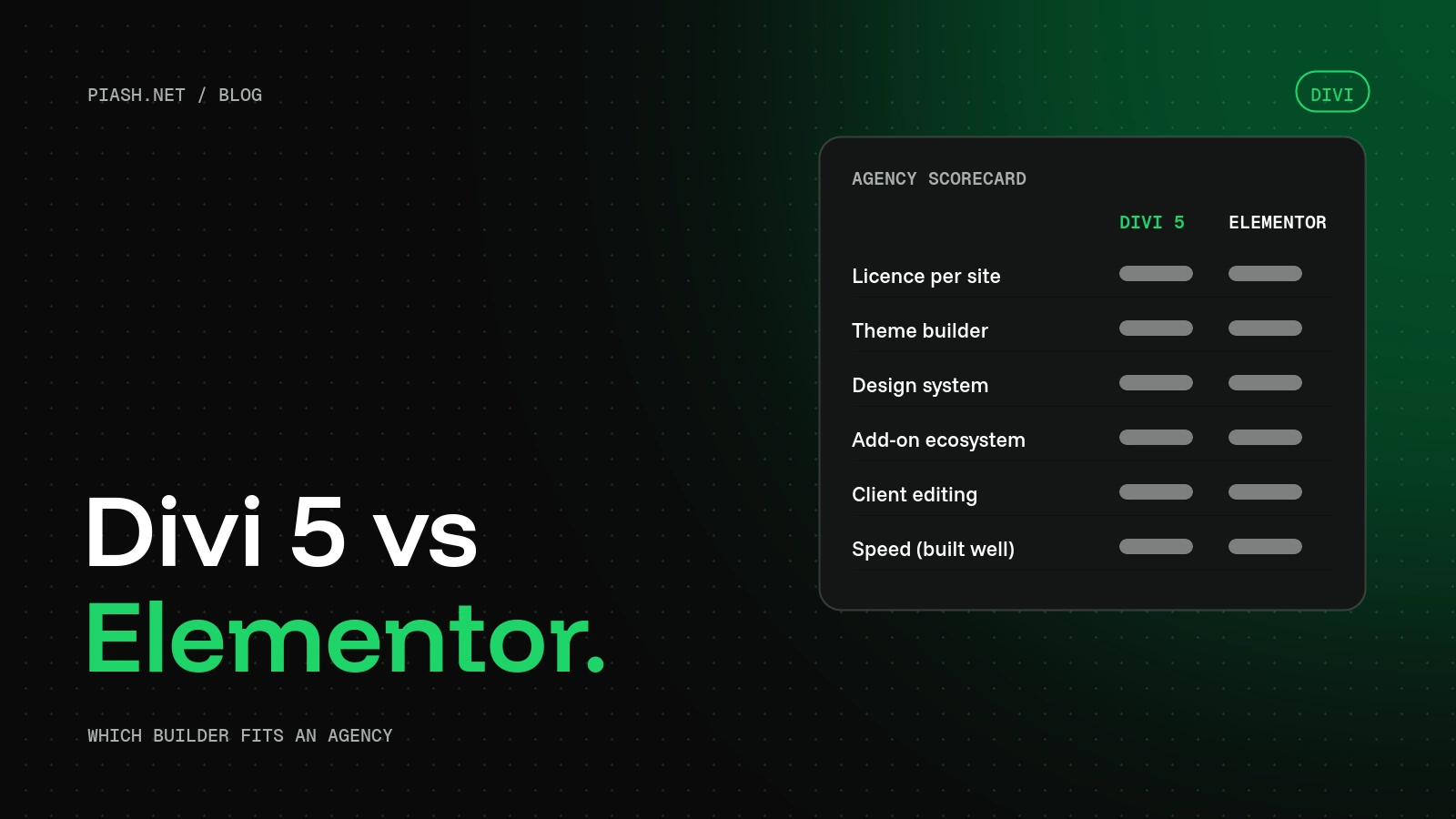
Both build excellent client sites. Choose Divi 5 if you launch many sites and want one licence, a built-in theme builder and a consistent design system across projects. Choose Elementor if your team and clients already know it and your workflow depends on its large add-on ecosystem. The builder matters less than how carefully the site is built.
I’ve built client sites in both for years, often for agencies that standardised on one or the other, and I built this site in Divi 5. This isn’t a “which is better” post. It’s how the two compare on the things agencies actually live with: cost per site, client editing, consistency, speed and lock-in.
Divi 5 and Elementor at a glance
| Divi 5 | Elementor (Pro) | |
|---|---|---|
| Licensing | One membership covers unlimited sites | Plans priced by number of sites |
| Theme builder | Built in | Included in Pro |
| Design system | Design variables and presets | Global colours, fonts and kits |
| Add-on ecosystem | Smaller, focused marketplace | Very large |
| Familiarity | Strong in the Divi community | Widely known by freelancers and clients |
| Speed | Fast when built carefully | Fast when built carefully |
Plans and prices change, so check both vendors’ current pricing pages before you decide.
Licensing and cost per site
This is where the two differ most for agencies. Divi is sold as one membership covering unlimited sites. Elementor Pro is sold in tiers based on how many sites you can activate. If you launch a handful of sites a year, the difference is small. If you launch dozens, or maintain a big portfolio of client sites, it adds up quickly and becomes a real line in your margins.
Also count the add-ons. An Elementor build that relies on two or three paid add-on packs carries those renewals too, often on every site.
Editing experience for your clients
Clients who edit their own content care about one thing: can they change a heading without breaking the layout? Both builders handle that well when the site is set up properly. Elementor is more familiar to many clients and freelancers, which helps if the client already has someone in-house. Divi 5’s editor is noticeably faster than Divi 4 and feels much closer to editing the real page.
Either way, the trick is the same: lock down the layout and give clients clear, simple places to edit text and images. A short screen recording at handover saves a lot of support emails.
Design systems and consistency
Agencies win when every page of a site looks like it came from the same system. Divi 5 leans hard into this, with design variables for colours, fonts and spacing, and presets you can reuse across modules. Elementor offers global colours, global fonts and kits. Both work. The real question is whether your team uses them, instead of styling each module by hand.
Performance
Both can be fast, and both can be slow. Page weight comes far more from how a site is built than from the builder’s name. These are the common causes I see in both:
- Styling every element by hand instead of using global styles.
- Loading fonts and assets the design never uses.
- Stacking add-on plugins for single effects.
- Huge, uncompressed images.
A real example from this site: Divi was loading a default font the design never used, adding about 170 KB of CSS to every page. Removing it cut the page HTML roughly in half. Neither builder will catch that for you. Someone has to look.
Dynamic content and ACF
Both support dynamic content from custom fields, so you can build listings, team pages and custom post types without hard-coding anything. If a project is heavily data-driven, like a directory, property listings or a large resource library, I often pair either builder with ACF and a little custom code rather than forcing everything through the builder’s interface.
Lock-in
Be honest with clients about this: any page builder locks a site in to some degree. If you switch builders later, plan for rebuilding the layouts, not a quick conversion. That’s true in both directions. Content in custom fields and posts moves easily. Layouts don’t.
My recommendation for agencies
- Already running on Elementor with templates, add-ons and a trained team? Stay. Switching costs more than it saves.
- Building many sites a year and want one licence, a theme builder and a clean design system? Divi 5 is a strong choice.
- Heavily custom or data-driven project? Consider Gutenberg with ACF and custom blocks, and keep the builder out of it.
Key takeaways
- Licensing is the biggest difference: Divi covers unlimited sites, Elementor Pro is priced by site count.
- Both are fast when built carefully. Build quality matters more than the builder.
- Set up design variables or global styles before building pages.
- Don’t switch a working agency stack just because something is newer.
FAQ
Is Divi 5 faster than Elementor?
Neither is automatically faster. A carefully built site in either can score well on Core Web Vitals, and a careless build in either can be slow.
Can I convert an Elementor site to Divi, or the other way round?
Not automatically in any reliable way. Plan for rebuilding the layouts. Posts, pages, images and custom fields move across without trouble.
Which is easier for clients to edit?
Both are easy when the site is set up with locked layouts and clear editable areas. Clients who have used Elementor before may find it more familiar.
Do you work in both?
Yes. As a white-label developer I build in whatever your agency already uses, including Divi, Elementor, Gutenberg and ACF.
You don’t have to change your stack to work with me.
I build in whatever your agency uses. If you have a design ready, see how I build WordPress sites from your design or send me the brief.